Concluding my first week in the garden, already I've found my hand pruners, a pair of pliers, and my old reading glasses, which I had written off years ago. If my summer garden bears half as abundantly as my spring beds, we will have a bountiful winter board, indeed.

Thursday, May 1, 2014


Thursday, April 4, 2013
Just As Desirable
Regard it just as desirable to build a chicken house as to build a cathedral.
Frank Lloyd Wright
Monday, April 23, 2012
A Limerick
There once was a girl from Nantucket
Who grew tired of her barn till she mucked it.
But having scraped up the piles, she broke out in smiles --
Ah, fresh bedding and flowers in the buckets.
Who grew tired of her barn till she mucked it.
But having scraped up the piles, she broke out in smiles --
Ah, fresh bedding and flowers in the buckets.
Thursday, January 5, 2012
My GwynnyDonk
I knew Gwynny was sick, but I didn't expect her to die. All summer, she had minced around like a Geisha, but I hadn't worried about it because she was old, 28 years is old for a donkey, and her doctor had told me years earlier to expect arthritis in her old age, given her history of white line disease. But by August, she didn't want to walk anymore. She looked stuck in place, interested but unable, as if her feet were glued to the ground. I had to take her morning corn stalk to her in the field, finally, because she wouldn't walk to the gate to get it. And she was slow. She didn't limp, she didn't falter, she just trudged. I could see she was uncomfortable, but I didn't think she was in pain, and I never thought she would die. I never thought she would die.
 |
| Gwynny in her first year with us, always the extrovert. |
 |
| Gwynny in her prime, always the opportunist. |
 |
Gwynny in her heart's home, always with her beloved Benjy.
|
Wednesday, December 14, 2011
One Week to Christmas
One week to Christmas. I don't have a single gift yet and the Christmas cards are still on the dining room table. The only thing that has changed is that Fred and I are now at each other's throats. He wants to mail the cards, and of course, with my writer's block, I don't.
I have baked 15 pounds of sugar cookies; that's 15 pounds on my hips, not on the tray. My sugar cookies, a recipe from America's Test Kitchen, are good enough for the dog and me to eat but not good enough to give away. Although I have read everything I could find about making them, every batch comes out dense, flat, and much too sweet. Every single time. This is despite the fact that my butter is precisely 65 degrees when I start and the room is 64; I cool my cookie sheets between batches; I have opened two new tins of baking powder; I have beaten the butter and sugar for 3 minutes, 5 minutes, and finally 10 minutes. What I do doesn't make a lick of difference -- the cookies are embarrassing. So I am giving up. I can't bake cookies forever. Fred's officemates are not going to eat them forever. Not the way they are. This will not be the year when I give away tins of pretty cookies.
Today I worked on Fred's decal instead. He wants to give sweatshirts to his surfer friends with a decal that says, surf for life. He doesn't realize how much time that can take, especially me, who is slow at everything. I have looked at fonts and found some graphics on the web. Maybe when he gets home we can put them together and get this thing on the road.
Christmas is just a week away.
Wednesday, December 7, 2011
A Christmas Note
We hope all are warm and well at your house, as we are here on our little farm.
We are waiting for winter now — snow is just to the south and west of us — and looking forward to the longer days that Christmas will bring. Here in the bare-branched silence behind our garden gate, I guess we are growing older.
And so goes another year. Ho, ho, ho! A merry Christmas to you all. We think of you often, always with best wishes.
It has been a good year for us, for the most part, though hard at times. A grand spring brought tall, wet grass for our horse and donkeys and freed Fred and me to travel, him with his surfboard to Costa Rica and me with my walking shoes to the Saint James Trail across northern Spain. Then, the summer broke my heart. It took my beloved Gwynnydonk who had been my companion and confessor for 21 years. We buried her beneath the treeline of the pasture, and now when I look out the window, I see just one horse and one donkey and a mound of red clay slowly melting into the ground where Gwynny used to stand.
Already on the day we buried her, the fall was coming on with spectacular beauty. I don’t know why, but the season has been just breathtaking. This time of year, we are mostly at home. We walk in the evenings. Fred has his fires in the fireplace, the dog and cat spraw in front of it, and eggnog warms in the microwave. I am occupied with my new paella pan, experimenting with shellfish and veggies. I love paella because it puts just one big dish on the table; it is a food of community, like breaking bread or sharing wine.
Already on the day we buried her, the fall was coming on with spectacular beauty. I don’t know why, but the season has been just breathtaking. This time of year, we are mostly at home. We walk in the evenings. Fred has his fires in the fireplace, the dog and cat spraw in front of it, and eggnog warms in the microwave. I am occupied with my new paella pan, experimenting with shellfish and veggies. I love paella because it puts just one big dish on the table; it is a food of community, like breaking bread or sharing wine.
Fred spent last weekend stretched out on the couch reading The Mighty Eighth, a collection of WWII memoirs, while I baked sugar cookies and sat at the dining room table grinding away at Christmas cards. These will be the first cards I have sent in many years. I don't know what has come over me.
We are waiting for winter now — snow is just to the south and west of us — and looking forward to the longer days that Christmas will bring. Here in the bare-branched silence behind our garden gate, I guess we are growing older.
And so goes another year. Ho, ho, ho! A merry Christmas to you all. We think of you often, always with best wishes.
Tuesday, March 8, 2011
The Infinity Scarf
Last week my husband brought home a plastic bag full of yarn, which was unusual for him, and he was quite mysterious about it.
When I looked inside, it turned out to be a scarf knitted by our friend Nancy. The card called it an infinity scarf and said that I should wrap it twice around my neck for warmth and comfort on the St. James Trail. The scarf is blue and burgundy; it's made of a soft wool and it's very fancy with little fuzzy flowers. It is a knitted ring, with no ends. You slip it over your head, twist it, and then slip it over again.
I don't know what to say. I am overcome. When preparing for a trip like the one to Santiago, it's rare to hear people say simply that they support you or even to ask you questions, other that that initial, seemingly innocent question whose purpose is to set up the dialogue. "So," someone might say, "how far do you think you'll walk in a day?" "Oh," I reply, "maybe 15 miles or so." And here it comes: "Well, if I were going, this is..." how I would take care of my feet (good socks and lots of moleskin), what I would eat (nuts and dried fruit), how I would stay hydrated (2 full waterbottles at all times), the way I would spend my time (with a group of fellow travelers), when I would go (it's winter, you know).... Someone asked me today, "Do you have a back-up emergency number?" "What if you can't reach Fred? What will you do then? What if he can't reach you?" All good to think about, but, as it turned out, the discussion was really about her brand new global phone. Last time I saw this person, it was the ride to the airport. She wasn't offering me one; she just wanted to make sure I had thought about it.
And then there are the people who should be going, too. "I envy you," they declare, and then they begin to pack. They point out what you should be taking (a cell phone, maps, a compass, a good pair of hiking boots) and what you should not be taking ("You're not going to take a cell phone, are you?" "No, not a book! All you need is YOUR book to record your experiences at night when you're not around the campfire." "A pancho?! No, not a pancho! You have to have a jacket!" How do people think of these things? They come so well prepared. They don't just mention things; they arrive with a point in mind. They have thought it through and worked out all the details. Any one of them could win the state debate trophy.
Sometimes they pause to see if I'm getting it all. "So," they ask, "are you going to do it that way?" and if I say no, I think I'll be doing it this way, sometimes they just stand there and stare. Sometimes they grimace a little or lift an eyebrow, but rarely, do they ask a question and almost nobody ever says, as Nancy did, I'll be thinking about you on your pilgrimage and I wish you well.
So, this is a treat and I am savoring it gratefully. Nancy, I will wear your beautiful scarf with affection, I will draw warmth and comfort from it, and I will carry your good wishes, or they will carry me, I hope, all the way to Santiago.
Thank you.
Thursday, March 3, 2011
Location, Location, Location
In a chicken coop, location is everything. Our coop has three roosts that define the neighborhoods like railroad tracks. The front roost, where Roy sleeps, is high-priced real estate indeed. Admission is by invitation only, which admit just three lucky hens a night. The other six birds sleep on the back roost, perhaps a little close to the wall and consequently streaked white with chicken poop. The chickens don't seem to mind. It's comfortable there and safe, though unexceptional -- a sort of avian suburb, you might say, with hens warehoused shoulder to shoulder in a row along the branch. Between those two perches and with one end right against the glass door, hangs the dreaded lower roost. The low roost is where a young hen was pulled from the house and killed last spring, while I was installing my automatic chicken door. An animal bent back the temporary wire barrier I had tacked up and pulled the little chicken partially through the hole, just far enough to bite off her head and leave the rest stuck there for the petsitter to find. Even now that the chicken door is up and working, birds who sleep on the low roost must occasionally come eye to eye with a raccoon peering inside. It's the kind of place a young girl dreams of leaving.
And leave they do, because in our coop the birds rotate. Roy sees to that. He moves the girls from neighborhood to neighborhood by issuing exclusive invitations to the high roost.
I should tell you that although Roy shares his roost with three hens each night, there are only two invitations because Roy has had a special girlfriend since he was a little yellow chick, we call her the Number One hen, and in addition to other perqs of high status, she always sleeps on his left. Roy sleeps in the center of his roost, and Number One sleeps on his left. Dorothy, our eldest, sleeps two places down on his other side, and a guest bird sleeps between. It's the guest who rotates. I don't know the rules, but I do know that Roy enforces them. I have seen him peck and crowd an interloper until she falls off the roost or moves to the back, so that someone else, the right bird, the invited guest, can fill the slot. Four birds, no more, no less, sleep on Roy's roost.

For a long while this winter, the guest bird was Arabella, with Ginger and Beulah taking turns from time to time, too, all mature hens. Young girls start out on the lower roost, and eventually graduate to the back one. All of ours have moved up -- nobody has used the lower roost since the incident -- but they still don't come uptown. Their day will come, but for now they mature in suburban safety.
The odd thing is that Roy doesn't seem to like Arabella much, or Ginger either, for that matter, but he lets them sleep next to him. Maybe the reason has something to do with fence mending or deference to age. Or maybe the hens draw straws or have another way of awarding time. For having lived with chickens for so many millennia, humans know little about their social systems. Except, of course, that they exist.
And leave they do, because in our coop the birds rotate. Roy sees to that. He moves the girls from neighborhood to neighborhood by issuing exclusive invitations to the high roost.
I should tell you that although Roy shares his roost with three hens each night, there are only two invitations because Roy has had a special girlfriend since he was a little yellow chick, we call her the Number One hen, and in addition to other perqs of high status, she always sleeps on his left. Roy sleeps in the center of his roost, and Number One sleeps on his left. Dorothy, our eldest, sleeps two places down on his other side, and a guest bird sleeps between. It's the guest who rotates. I don't know the rules, but I do know that Roy enforces them. I have seen him peck and crowd an interloper until she falls off the roost or moves to the back, so that someone else, the right bird, the invited guest, can fill the slot. Four birds, no more, no less, sleep on Roy's roost.

Roy sleeps in the middle of the front roost and Number One sleeps beside him.
For a long while this winter, the guest bird was Arabella, with Ginger and Beulah taking turns from time to time, too, all mature hens. Young girls start out on the lower roost, and eventually graduate to the back one. All of ours have moved up -- nobody has used the lower roost since the incident -- but they still don't come uptown. Their day will come, but for now they mature in suburban safety.
The odd thing is that Roy doesn't seem to like Arabella much, or Ginger either, for that matter, but he lets them sleep next to him. Maybe the reason has something to do with fence mending or deference to age. Or maybe the hens draw straws or have another way of awarding time. For having lived with chickens for so many millennia, humans know little about their social systems. Except, of course, that they exist.
Monday, February 21, 2011
The First Piece of Equipment
Did you have a good Valentine's Day? It's my favorite. A personal, low-key celebration of love. No pressure, no hassle. I like that.
This is the card I gave my honeybaby this year. It looks a little self-absorbed and maybe it is. But really, it's a thank you for all the support he shows me, especially this year. My honeybaby knocks himself out for me. Sometimes it takes my breath away.


And this is what he gave me.

The scallop shell is the emblem of St. James and the mark pilgrims wear on the St. James Trail. And so my supportive, thoughtful husband tracked down these earrings. He calls them my first piece of technical equipment. And I call them that, too. They are my anchor. The shells tie me to St. James, but the earrings tie me to home.
Thank you, Bud.
This is the card I gave my honeybaby this year. It looks a little self-absorbed and maybe it is. But really, it's a thank you for all the support he shows me, especially this year. My honeybaby knocks himself out for me. Sometimes it takes my breath away.


The scallop shell is the emblem of St. James and the mark pilgrims wear on the St. James Trail. And so my supportive, thoughtful husband tracked down these earrings. He calls them my first piece of technical equipment. And I call them that, too. They are my anchor. The shells tie me to St. James, but the earrings tie me to home.
Thank you, Bud.
Saturday, February 12, 2011
A Walk to Remember
The New York Times reported good news last week for all of us who love to walk but can't always remember where we left our shoes. Regular walking -- just 40 minutes a day, three times a week -- can improve memory. Here, read it yourself.
A Walk to Remember? Study Says Yes
By PAULA SPAN, Published: February 7, 2011
(Reproduced from The New York Times)
In healthy adults, the hippocampus — a part of the brain important to the formation of memories — begins to atrophy around 55 or 60. Now psychologists are suggesting that the hippocampus can be modestly expanded, and memory improved, by nothing more than regular walking.
In a study published on Jan. 31 in The Proceedings of the National Academy of Sciences, researchers randomly assigned 120 healthy but sedentary men and women (average age mid-60s) to one of two exercise groups. One group walked around a track three times a week, building up to 40 minutes at a stretch; the other did a variety of less aerobic exercises, including yoga and resistance training with bands.
After a year, brain scans showed that among the walkers, the hippocampus had increased in volume by about 2 percent on average; in the others, it had declined by about 1.4 percent. Since such a decline is normal in older adults, “a 2 percent increase is fairly significant,” said the lead author, Kirk Erickson, a psychologist at the University of Pittsburgh. Both groups also improved on a test of spatial memory, but the walkers improved more.
While it is hard to generalize from this study to other populations, the researchers were delighted to learn that the hippocampus might expand with exercise. “And not that much exercise,” Dr. Erickson pointed out.
People don’t even have to join a gym, he noted. They just need shoes. PAULA SPAN
Monday, February 7, 2011
Locking It In
I got an email from the Pilgrim Office in St. Jean Pied de Port last week. It said their doors are open till 10:30 on Saturday nights and the hostel will have plenty of room on March 19, no reservation required. That means my schedule is good. I will arrive in St. Jean just in time for supper under a full moon, and when I step onto the St. James Trail the next morning, it will be on the first day of spring.
If I felt uncertain about this trip, I feel certain now. With such omens, surely the wind will lie calm on the mountain and there will be no snow. Not right there where the trail begins its steep scramble into the French Pyrenees or where it crosses the pass to Spain. The signs say the sky will light my path; winter will give way to spring. They tell me to pull up AA.com on my laptop and lock in my plane tickets. And so I do.
But, Good Lord, there is so much more to be locked in here before I go. I have to get everything ready on the farm so Fred and our petsitters can manage it while I am gone. That means putting up permanent fencing around my donkey pasture to replace the electric wire Gwynn keeps walking through. I have to put new sawdust in the stalls and lay in enough hay to last till I get home. I have to introduce my donkeys and horse very gradually to spring grass. If they graze too long in the beginning, they will founder.
At the last minute, I'll need to plant my spring garden: bok choi, beets, broccoli, Brussels sprouts, cabbage, carrots, greens, lettuce, onions, spinach, and green peas -- lots of green peas. We'll have to till it with the tractor and rotovator because I put so much sawdust and manure on it over the winter. Then we'll cover the tilled ground with newspapers and cover the newspapers with mulch to lock in the moisture and prevent weeds from coming up. Thank goodness, that system works like a charm; Fred won't have to do a thing in the garden while I'm gone, except maybe harvest some of the greens. I'll be home in plenty of time to put in the summer beds.
But right now, today, I need to start seeds for my broccoli, Brussels sprouts, and cabbage, so I can get them in the ground before I leave. I start my own because our chickens make store-bought transplants so expensive. One way or another, they usually manage to break into the garden and eat our first spring planting and sometimes even the second; three rounds of store-bought plants can add up to $15 to $30, and that's too much. So, I start my own. A $1.97 pack of seeds will make plenty for our birds, for us, and for our freezer, and of course, we like to share when we can.
I have to plant more native shrubs, too, and make wire cages to protect them from the deer. After battling invasive vegetation on our farm for 10 years, we are just now coming free of it; and we're finding it's at least as hard to restore the natives as it was to get rid of the invasives. The deer eat everything we plant because there is so little else for them now that the native understory is gone. And, of course, as long as we have no understory, there will be erosion. So I am trying to restore the plants, and right now is the season.
At least I won't have to worry about it over the spring because I'll be gone.
If I felt uncertain about this trip, I feel certain now. With such omens, surely the wind will lie calm on the mountain and there will be no snow. Not right there where the trail begins its steep scramble into the French Pyrenees or where it crosses the pass to Spain. The signs say the sky will light my path; winter will give way to spring. They tell me to pull up AA.com on my laptop and lock in my plane tickets. And so I do.
 |
| Gwynn is the bad one. |
I have to fill the freezer with quick dinners -- pot pies and quiche and tomato sauce -- because, as long as he is feeding and mucking in addition to going to work every day, Fred won't have much time to cook. I have to iron shirts and hang the new tv on the wall. I have to clean the chicken house, buy grain and sunflower seeds, and fill all the feeders. I need to put a flotation device in the donkey trough to make it refill automatically. I need new automatic waterers for the chickens, too; the current ones leak.
 |
| Our garden has six beds like these. |
 |
| Maybe by mid-March |
 |
| This pink lady slipper is our favorite native plant. |
At least I won't have to worry about it over the spring because I'll be gone.
Bueno, eh?
Sunday, February 6, 2011
Packing
So, I am about to go off to TJ Maxx in search of clothes to take with me on the St. James Trail. That might make a purist's skin crawl (Bill, are you reading this?), but I am looking for comfort and easy-to-care-for, and I really don't care where they come from.
The websites I have looked at advise walkers not to carry more than 10% of their body weight. For me, that would be 13 pounds, but I will try to limit my load to closer to 4 or 5 pounds because my arthritis probably won't tolerate more. I can't carry any weight on my back; it will all have to go around my hips, so I am giving this a lot of thought. I'll need a water bottle, some pills, a toothbrush, toothpaste, comb, deodorant, soap. I'll need socks and undies, gloves, a hat, and a change of clothes. I'll need a couple of tiny plastic panchos for the rain, something for the cold, and some sort of sleeping bag (good to 32 degrees) for the hostels. I'll need a light, a camera/phone, an ID case, and some first aid things, and I would love to take something to read. I haven't weighed all that out yet, but I am hopeful.
For clothes, I plan to take tights and a shift -- a tunic of some kind, washable, lightweight, and tough. That's what I am shopping for today. I don't really expect to find it; in the back of my mind, I guess I expect to have to make it, if I can find a suitable fabric.
While I'm out today, I will also try to walk my 5-mile loop. I have walked twice this week so far and it's going well, but I think I need to pick up the pace. So, if I survive this afternoon's walk, I think I'll add another mile or two here in the neighborhood after supper. We'll see how that goes.
This trip is beginning to look possible -- no pain, no shin splints so far. Up to this point, my plane tickets have been on hold, but if I am still standing after 7 miles, I will lock them in before bed tonight. Big day.
Tuesday, February 1, 2011
Training
I should tell you first that I have always been a walker; this trek on the St. James Trail will not be my first. There's just so much to see in this big ole world and, as A.E. Houseman said, "...to look at things in bloom, fifty springs are little room." So, I have roamed as much as I could and am oh so eager to go again.
With 45 days remaining till departure, I am in Day 5 of preparing and have just laid out a walking program. If you have been a boy scout, you will recognize at least part of it.
Walking is sometimes easy and sometimes not, but it always pays to be prepared. I walked 28 miles my first day on the Morman Trail, and it almost killed me because I had only prepared for 14. By the time we finally stopped for the night in Casper, Wyoming, I could barely catch up with a piece of litter drifting by on the breeze. I needed help to put up my tent -- no, well, let's be honest -- somebody pretty much put up my tent for me and all I did was crawl in and pass out; but I walked 14 miles the next day, stayed on to the end, and cried like a baby when it was over. So all's well that ends well, but I wouldn't recommend the experience: it pays to be prepared.
Since developing arthritis five years, I have become sedentary. I do still walk from time to time, usually three or four miles, sometimes five, and usually at about 3 1/2 miles per hour. At that rate, I'll have to walk 4 to 5 hours a day for 32 days to finish the St. James Trail by Good Friday. And that's how I approach this walk: it's not the miles that matter as much as the time; if I can put in the 5 hours, the 15 miles will take care of itself.
I try to walk almost every day. I walk until I begin to feel tired and then I turn back to where I began. If that wears me out, especially if I feel it in my shins or my shoulders, I take a day or two off. When the discomfort has subsided, I walk again, less distance or more, it doesn't matter -- whatever feels right. I don't set goals or watch the clock. I don't tell myself, "Okay, today you'll walk 5 miles." Because as long as I don't hurt myself or make myself hate it, I will do it again, and each time, I will just naturally go farther than before.
This is not to say that I don't care how far I go, because I do. In fact I am thoroughly obsessive about the distance. I clock all my walking routes and I know exactly how long they are and mileposts along the way. It's just that I don't push myself. When I have walked as far as I want, I take a look around to see where I am and then I turn around and head for home. That's all there is to it.
So here's how the training has gone so far. Day One, I spent driving my route and noting the distances along the way. I know the 1, 1 1/2, and 2 1/2-mile marks (twice that makes a round trip). And that's all I need because on the trail I plan to walk in 2-hour increments of about 6 to 7 miles at a time. So, when I can walk my route twice in a day, comfortably, without shin splints, leg cramps, pulled muscles, or exhaustion, I'll be ready to go. Well, except for one thing. Right now I'm walking on level ground, but before I go, I'll have to add hills.
When the 5-mile loop is comfortable, I'll add two last miles, which go down a hill. I haven't driven them yet or marked the mileposts, but I will. Right now, I have enough to think about with just the flat land, and I am not going to worry about that stupid hill. When the time comes, it will still be there. But I know I have to climb it before I leave.
And one more thing, too. At least once before my departure, I want to walk in the mountains, 12 to 15 miles at 3,400 feet, which is what it will take to cross the Pyrenees. I hope it will be cold and miserable. That way the Pyrenees won't be too much of a surprise, and my biggest worry there will be finding the signposts in the fog rather than coping with the ascent, the distance, or the temperature. So, that was Day One, working out the route and the distances and the hill -- and making the plan.
Day Two, I walked. I intended to do three miles but wound up walking four. It isn't my legs I have to watch out for, it's my shoulders because of the arthritis, and the four miles left a mark. So for the following two days, until I felt perfectly normal, I stayed home. Today is Day 5. I am feeling quite swell, so I will go again.
Saturday, January 29, 2011
Expectations
What do I expect of the St. James Trail?
I expect it to rain 22 times.
I expect to walk 6 hours a day and sleep 10.
I expect days to be short and dim.
I expect people to be kind.
I expect mud.
I expect wildflowers.
I expect old churches and Celtic beehives.
I expect to be homesick.
I expect spare accommodations.
I expect freezing nights.
I expect to be overwhelmed by beauty.
I expect my foot fungus to act up.
What do I hope for?
I hope to find fresh vegetarian food.
I hope my camera works.
I hope my Spanish is good enough.
I hope to have energy to read.
I hope to see a multitude of virgins.
I hope to see the prince.
I hope my back tolerates this.
I hope my husband misses me.
I hope my animals stay healthy.
I hope to be overwhelmed by beauty.
I hope I make it.
Wednesday, January 26, 2011
THE WALK
It's official: I am going back to Spain this spring to walk the St. James Trail. In just seven weeks, I'll be flying overnight to Paris and from there taking the midday train to the foothills of the Pyrenees. I'll have supper in St. Jean Pied de Port and try to get a good night's sleep because I'm going to need it. From the city's west gate, it's 10 miles straight up to the Roncevaux Pass and from there, another 470 miles and two high ridges to the gravesite of St. James the Apostle. I'll have 32 days.
They say the first day on the trail is the hardest because the path across the Pyrenees is so steep and cold, but the rest should be better. I hope that's true, because I'll have to average 15 miles a day to reach Santiago de Campostela by Thursday of Easter Week, and I'm no longer a spring chick.
If I finish by Thursday, I'll have time to go to Seville for the end of Holy Week. On Good Friday, the Basilica de la Virgen de la Esperanza Macarena brings out its unique Crying Virgin and parades her through the streets in the Semana Santa procession of penitent brotherhoods. The Virgin of the Good Winds is in Seville, too, and the Archive of the Indies -- thousands of documents and artifacts that date back to the conquest. One long unfettered weekend, that's all I ask.
Yes, of course, that's plenty for one trip, but there is one thing more. As a bonus day, I am flying home through London on April 29, the prince's wedding day. If the plane lands on time, I'll be in the city by 9 that morning, with time to hustle over to Westminster for a glimpse of the royal carriage as it leaves the church and a quick tour of the British Museum before I have to scuttle off to Heathrow for my 7:00 p.m. flight home. Just one portion of fish and chips would make it a perfect day.
And that's it. This will be my third long-distance trek, but my first in another country, my first in another language, my first by foot, and my first as a senior citizen. So there may be surprises. All I know right now is I need to walk, walk, walk and I need to study my Spanish. Fifty days, that's all I have.
I'll keep you posted.
They say the first day on the trail is the hardest because the path across the Pyrenees is so steep and cold, but the rest should be better. I hope that's true, because I'll have to average 15 miles a day to reach Santiago de Campostela by Thursday of Easter Week, and I'm no longer a spring chick.
 |
| The Crying Virgin |
If I finish by Thursday, I'll have time to go to Seville for the end of Holy Week. On Good Friday, the Basilica de la Virgen de la Esperanza Macarena brings out its unique Crying Virgin and parades her through the streets in the Semana Santa procession of penitent brotherhoods. The Virgin of the Good Winds is in Seville, too, and the Archive of the Indies -- thousands of documents and artifacts that date back to the conquest. One long unfettered weekend, that's all I ask.
Yes, of course, that's plenty for one trip, but there is one thing more. As a bonus day, I am flying home through London on April 29, the prince's wedding day. If the plane lands on time, I'll be in the city by 9 that morning, with time to hustle over to Westminster for a glimpse of the royal carriage as it leaves the church and a quick tour of the British Museum before I have to scuttle off to Heathrow for my 7:00 p.m. flight home. Just one portion of fish and chips would make it a perfect day.
And that's it. This will be my third long-distance trek, but my first in another country, my first in another language, my first by foot, and my first as a senior citizen. So there may be surprises. All I know right now is I need to walk, walk, walk and I need to study my Spanish. Fifty days, that's all I have.
I'll keep you posted.
A Theory About Molting Hens
So, now I have a new idea about why hens don’t lay eggs over the winter. I had been thinking it was because they're molting; you know, a molting hen lays no eggs. But, of course that can't be right. This year, although only one of our hens molted, eight took the winter off. Clearly, it's not the molting that matters.
My new theory is that it's not the molting, it's the daylight, and I have tested it, at least rudimentarily. This year, our girls stopped laying about 10 days before Thanksgiving. That would be around November 15th, and they started laying again a couple of days ago, about January 24th. That would mean they stopped about 34 days before the shortest day of the year and started again about 34 days after. And there you have it. It could be coincidence, of course, but more likely, it's the daylight that matters. I’ll be willing to bet my best layer cake on it next year.
As to the other odd thing about the winter lay-off, I don't have a clue. Why is it that it's mostly the older hens, the two-year-olds and up, who stop laying when the first-year girls continue right along through the cold months? Can the younger girls get along with less light, or what?
Wednesday, December 29, 2010
The Tenor
I love opera. Sometimes it makes my heart beat so wildly that I expect the people around me to start shushing. I love it when the tenor's voice strains for the high notes until it sounds thin enough to rip apart like old cloth. That's why I wanted to see Carmen in Barcelona last fall.
We didn't have tickets because they cost $225 and we are but humble farmers, but I had read somewhere that the Gran Liceu holds out a few to discount on the day of the show. So on our way back from Gaudi's Sagrada Familia on Saturday evening, I stopped at the box office. It was about 5:00, and the window was still closed, but there was already a lady waiting beside it on the bench.
The lady told me she had flown in from Switzerland just to see Carmen because the Barcelona opera is the best in Europe and the tenor scheduled for that night was the season's fair young man. Her story weakened my knees just a little, and I sank onto the bench beside her; soon, a German couple and their friend joined us there, and with the bench filled, a Spanish couple started the line up the steps toward the street. After that, people just poured in. A sign said to take a number, the box office would open at 7:00 p.m. That's right; at the Gran Teatre del Liceu in Barcelona, the queu take numbers.
Our only discomfort was that the little number dispensing machine wasn't working. Every time somebody new showed up, he came downstairs to where we were waiting, pushed the button, and got a ticket that said No Servicio. Someone from the bench, usually the German friend, would explain that the machine was broken, the box office would open at 7:00, and we headed the line; and then she would count us off, Swiss lady number 1, me number 2, German couple 3 and 4, friend number 5, and the newcomer would go up the stairs to wait. But every time we did that, I guess we felt a little more vulnerable because the only thing that stood between our orderly line and a crushing mob was bare naked civility. With one little push, we could all be characters in an opera of our own.
And sure enough, before long, the pusher arrived. We knew her before she opened her mouth. Something about her stood out like a boil on a baby's bottom and none of us could take our eyes off her. She was aloof and glowering and she did not return up the stairs after we had explained about the dispenser and the line. Instead, she just stood there at the bottom, studying our faces and surveying the room like a mechanical, shrouded lighthouse. For what seemed a very long time, we returned the stare, but no one really moved until the German man stepped forward.
Like a tenor, he was a very large middle-aged man, and he somehow managed to get right down into the woman's face. It began as a duet -- he ordered her up the stairs, she declined, he began to taunt her, she replied in kind -- but then the rest of us joined in for a grand, full-company number. People jeered over the rail and shook their fists; people began to spill down toward the floor. Over in my corner by the ticket window, I imagined a crushing melee because the woman was out of line. I hear from time to time Americans say they don't want to go to Europe because Europe is so much like the states. But Europe has its own character. Although we Americans love our sports, we don't make operas like the Europeans. We don't riot when someone steps out of line.
But our group didn't riot that day either. In fact, the number ended inexplicably, abruptly and silently. The woman scanned the room as if to say, "I'll get you and your little dog, too." And when she had seen enough, she backed onto the stairs, stooped and whirled just like in the movie, and simply melted away.
The crowd went wild, of course. In an opera at this point, the chorus would be singing cheerfully, turning awkwardly back and forth among themselves, patting each other on the back, and nodding their heads like church goers giving a reluctant kiss of peace. On the stairs, people did much the same, acknowledging one another, patting themselves on the back, and when the ticket booth finally raised its shades, it jubilantly ushered the Swiss lady to the first window and me to the second. But, jubilation notwithstanding, this last act is sad. The ticket lady held up a seating chart and said in English -- and I paraphrase here -- that the only seats I could afford were behind posts. A man had come into the building an hour earlier with center orchestra seats for €149 each, the internet price, and I had turned them down. And now, the ticket lady was lifting the shell to reveal that the pea was not there. And out I walked, empty handed.
It was Saturday night in Barcelona and I had nowhere to go. Fred was napping at the hotel and Bill and Susan were nowhere to be found. We were hosteled in the medieval quarter, right on Las Ramblas. So I decided to walk.
Normally when I am feeling low, I just walk until the seratonin kicks in, but that night its little foot must have fallen asleep. I made my way from Las Ramblas to the cathedral, stopping along the way to see the old city wall. I read the history of Ramon Berenguer and listened for a while to a Chilean street harpist and then to a violinist. But I had to drape my bottom lip over my arm to keep from tripping over it, and not even the historic markers cheered me up. The narrow, winding alleys made it hard to keep up with where I was and the night chill was forming -- all of this to say that I was just turning a corner from bad to worse when I heard someone singing.
It was a confident, soaring voice backed by an inconceivable full orchestra and chorus. My failing spririt caught hold of it and rode it like a wave to shore. For, you see, children, miracles do happen, even to the worst of us.
There in the alley behind the ancient Cathedral of the Holy Cross and Saint Eulalia stood a tenor. He was dressed in a baggy black shirt and pants and a bright coral jacket; he had greasy shoulder-length hair; and he was straining for the high notes until his voice tore like old cloth. His orchestra was a little Karaoke boom box on a hand cart; his chorus was six retirees in lawn chairs. They were reading the lyrics from cheat sheets.
 |
| The Tenor |
There in the alley behind the ancient Cathedral of the Holy Cross and Saint Eulalia stood a tenor. He was dressed in a baggy black shirt and pants and a bright coral jacket; he had greasy shoulder-length hair; and he was straining for the high notes until his voice tore like old cloth. His orchestra was a little Karaoke boom box on a hand cart; his chorus was six retirees in lawn chairs. They were reading the lyrics from cheat sheets.
I sat down on the steps to a 15th-century doorway. The tenor sang The March of the Toreador from Carmen, La Donna a Mobile from Rigoletto, and some others I couldn't name. Then he played an introduction to O Solo Mio on his boom box and invited us all to sing along. I pulled out my little Olympus voice recorder and captured it. I wish I could get the file to load here, but I'm afraid you will have to use your imagination. And if you do, people, be generous, because it was very, very grand.
This is the chorus -- the three people standing in a row and the three people sitting upright in front of them.
This is the chorus -- the three people standing in a row and the three people sitting upright in front of them.

Every now and then the tall man stepped out of the line and hobbled into the alley to pick up a satchel.

He passed it around the crowd for donations and then put it back where he had gotten it and returned to his place in the chorus. I gave the tenor all the money I had with me, but it was nowhere near the 149 Euros, I owed.

The tenor was from Zaragoza, but I don't remember his name, and I have not been able to find him on the internet. If you know him, if you see him, please tell him I mentioned him. And, if you would, please tell him, "Thank You."
Wednesday, December 22, 2010
Holiday Eggs
I do most of my baking in the two weeks before Christmas, mostly sugar cookies and shortbread, but sometimes pecan chewies or a pie and once in a while a cake. I clear out the kitchen and haul in a storehouse of sugar and flour, nuts, dyes, spices --everything but the eggs. I don't buy eggs because we raise those here.
I say we raise them here, but this time of year our supply can be a little iffy because our hens stop showing up for work. They are molting right now -- visibly shedding -- and there is a deep wind row of feathers beneath their roost in the chicken house. It's odd that they start just as the weather turns cold, being half-naked for most of it, but they do. In our climate, they start in mid-November and shed right through the holidays. They won't lay again until they have a bright new coat of feathers sometime in January.
Fortunately, it's just the A-Team, the mature hens, who molt. The Junior Varsity, born last spring and still sporting brand new feathers from the summer, are on the sideline, and we call them in. They have only been laying for a few months, so their eggs are smallish, but they pull us through.
We have just two youngsters on the job this year and they are laying a single egg a day. So this time of the year, we are strategizing all the time. Shall we eat it or save it? Shall we go ahead and make sugar cookies or save up for a coconut cake? Can we afford to give this egg away or should we hoard it with the others? Ah Lordy, the holidays. I hope Santa can't see this.
And we strategize over the hens, too, buying a couple of chicks each spring just for the holiday eggs. We figure that if most of them live for seven years, as they tend to do, our flock will top out at around a dozen. And for us that's a pretty good number.
Twelve hens should give us a thriving egg business next summer. We'll have two or three dozen a week to sell, plenty for grits and eggs on the weekends, and a few left over to bake with. The new girls will keep the flock young. Their eggs will help pay for chicken feed, endow the chicken retirement fund, and give my husband a little walking around money for the Starbucks coffee he craves. That way, everybody gets what they need, and nobody gets edgy.
And, of course, the baked goods are tasty, too. Pecan chewies this year and a couple of caramel cakes -- all made with fresh, home-grown, not jumbo but big enough eggs. You have to love the holidays. Nothing says lovin' like somethin' in the oven.
 |
Just look at this bird! If I had a hair day as bad as hers, I might skip work, too. |
Fortunately, it's just the A-Team, the mature hens, who molt. The Junior Varsity, born last spring and still sporting brand new feathers from the summer, are on the sideline, and we call them in. They have only been laying for a few months, so their eggs are smallish, but they pull us through.
We have just two youngsters on the job this year and they are laying a single egg a day. So this time of the year, we are strategizing all the time. Shall we eat it or save it? Shall we go ahead and make sugar cookies or save up for a coconut cake? Can we afford to give this egg away or should we hoard it with the others? Ah Lordy, the holidays. I hope Santa can't see this.
And we strategize over the hens, too, buying a couple of chicks each spring just for the holiday eggs. We figure that if most of them live for seven years, as they tend to do, our flock will top out at around a dozen. And for us that's a pretty good number.
Twelve hens should give us a thriving egg business next summer. We'll have two or three dozen a week to sell, plenty for grits and eggs on the weekends, and a few left over to bake with. The new girls will keep the flock young. Their eggs will help pay for chicken feed, endow the chicken retirement fund, and give my husband a little walking around money for the Starbucks coffee he craves. That way, everybody gets what they need, and nobody gets edgy.
And, of course, the baked goods are tasty, too. Pecan chewies this year and a couple of caramel cakes -- all made with fresh, home-grown, not jumbo but big enough eggs. You have to love the holidays. Nothing says lovin' like somethin' in the oven.
Wednesday, December 15, 2010
Rhode Island Reds and Dominiques
 |
| Georgie Moss Lewis and my sisters Betty and Barbara. |
My grandparents have been gone for more than 40 years now, but when I was a child they had a farm in Tennessee. Their white frame house stood on a piece of high ground with cotton fields in front and pasture behind. It had a fireplace in the living room and a hand pump just outside the back door. It had a concrete front porch, a single bedroom, and a kitchen with cold running water. When my sisters and I were infants, our parents used to bath us in the sink. When we grew too big for that, they heated water on the stove to fill a tin basin on the floor. I can remember sitting in that tub surrounded by family going about their business. My baths were public and drafty, but to their credit, they were better than running to the outhouse in rain.
 |
| The house was surrounded by cotton fields. |
In the year when my father was dying of lung cancer, we talked about his upbringing. "We didn't have nothing," he said. "We never had nothing." But as I remember it, my grandparents had quite a bit. For one thing, they were healthy and, I couldn't help noticing even as a seven-year-old, inordinately handsome. For another, they liked each other. They smiled a lot and their eyes crinkled, and they had four doting sons who visited often and sent money when they couldn't.
 |
| My father Jim Lewis and his father Noel. |
But good looks and good cheer don't necessarily put food on the table and the money must not have gone far. In a climate that ranges from 10 inches of snow to 100+ degrees, my grandparents never lived in a house with insulation, they never had an indoor toilet or a telephone, never owned a car or a home. Until they moved to my father's farm, they had been tenent farmers. Their last house, in Mississippi, had only a deep well on the back porch -- that's right, the kind you dip water out of with a bucket, and the porch was built right over it -- and when it went dry, my grandfather hauled water on foot from the neighborhood store, a mile up the road, on the highway. That was in 1966, and he was almost 80 years old.
It's no wonder their lifestyle has passed away. And no wonder chickens are not always welcome these days, reminders as they are of such times. I'm glad for the comforts I have and for the ease my animals share. But I am also glad for the people and places I loved as a child and grateful for the memories. And for my Rhode Island Reds and Dominiques who keep them alive.
Tuesday, December 7, 2010
The Automatic Chicken Door -- How To
My automatic chicken door has been up and running for four months now, and so far, knock on wood, it has been as faithful as a postman. It is built of scrap wood and Lucite and runs on the little Add-A-Motor D20 Chicken Coop Motor from Smarthome.com. In case you are contemplating a new door for your chicks, here's how I built it.
I used:
(2) 2x4 boards, 36 inches long
(2) 2x4 boards, 12 inches long
(1) sheet of PGLA .220 Lucite (a competitor of Plexiglas), 12"x18"
(1) strip of aluminum slatwall insert, 3' long
(1) screw hook, to attach the string to the door
(1) handful of nails
(1) Add-A-Motor D20 Chicken Coop Motor
(1) lamp timer
All that cost about $120, which was more than I wanted to spend, but after letting my birds in and out every day for 12 years, I decided it was worth the money. Of the total, about $20 went for construction materials, and the rest paid for the motor. In the time since I bought them, the materials have gone up in price and the motor has come down, but the bottom line is about the same.
Some doors are at ground level. Mine is elevated, with a ramp for access, and my chickens love it. I put rungs on the ramp at chicken footstep intervals, about 3 inches apart. The rungs are closer together than I expected them to be; I just kept adding until my birds stopped sliding.

My door was complicated by being framed inside an existing screen door. Your door, started from scratch, would be simpler to install. In either case, the design consists of three parts: the framed doorway, the sliding door itself, and the motor.
The doorway is 12" wide and 18" high, just big enough for my Rhode Island Red rooster Roy to get through if he ducks his head a little. You can check the best fit for your birds by putting ruler marks on a post or wall of your coop or leaning a yardstick against it and measuring your birds as they walk by.
The door is a Lucite panel that runs up and down in aluminum tracks. Lucite, Plexiglas, Masonite, and tin (not wood) are ideal materials because they are strong, lightweight, and waterproof and will slide without sticking. Up-and-down doors are more common than models that open from side to side and smaller doors are preferable to larger ones. Four pounds seems to be all a little motor can lift, and doors with shorter sides have less opportunity to bind against the frame.
The motor sits inside the coop and above the door frame. It works like a fishing reel, spinning first one way and then the other to raise and lower the door on a string. The lamp timer controls the schedule.
Aluminum slatwall inserts hold the Lucite in place and guide it up and down. They are tacked to the insides of the door frame and they look like this:
I used scrap wood to frame my doorway and bought the rest of my materials from Lowe’s Home Improvement Store. Lowe's sells the Lucite in 18” X 24” sheets and the aluminum slatwall inserts in 6’ strips. I had the store cut both in half for me, so what I took home was two 18” X12” panels of Lucite and two 3' strips of slatwall. If I had bought the wood there, I suppose they would have cut that, too. My timer is just a standard $4 lamp timer, also from Lowe's.
All I had to do when I got home was (using an existing entry into the chicken house):
I am particularly pleased with the bottom sill of the doorway. I grooved it to deter raccoons from poking their little claws underneath the closed door and trying to lift it.
I used the remaining half of my Lucite sheet to cover the top of the opening in my door. I tacked it tightly against the tracks as a permanent cover, but that was necessary only because I started with an opening that was twice as tall as I wanted in the first place. If you are starting from scratch, cut an opening exactly the size you need and be done with it. Share the extra Lucite with a friend.
Although the framing went well, the motor is a different story. I started with a motor that was too complicated for me and wasted quite a bit of time before I finally gave up on it and found a simpler one that I could install, adjust, and maintain by myself.
The first motor was the DIY model described on Chris and Keri's Blog. I liked it because it was inexpensive and hand-made and clever, but in retrospect, Oh My God, What was I thinking?! Chris and Keri's motor is a mass of electrical wiring and limit switches and a jerry-rigged screwdriver with a soldered circuit board that I don't even begin to understand. Look at Chris and Keri's material list carefully. If you don't recognize the parts or know what they're for or how they work, possibly this motor is not the best choice for you either, Grasshopper.
Master Po: Close your eyes. What do you hear?
Young Caine: I hear the water, I hear the birds.
Master Po: Do you hear your own heartbeat?
Caine: No.
Master Po: Do you hear the grasshopper which is at your feet?
Caine: Old man, how is it that you hear these things?
Master Po: Young man, how is it that you do not?
Pilot episode of Kung Fu (1972)
My friend Keith built Chris and Keri's motor for me; all I had to do was make it work. But I had immediate problems with the limit switches, which I never got the hang of, and after I had fiddled with the screwdriver for a while, it stopped working, too. The underlying problem was that I could not hear the grasshopper of the assembly which was at my feet. Although Chris and Keri's design is a boon to those with better ears, my destiny lay with a factory-built model and a warranty.
I got on the internet and bought the Add-a-Motor Chicken Coop Motor Model D20. On the negative side, it's made in China, it cost me almost $100 (although another company sells it cheaper now), and it’s not the hand-made gift my friend Keith made for me. On the positive, it arrived in 2 days, it’s small and manageable (it looks like a big white thermostat, with all the parts inside where I don't even have to see them), it has a warranty, and its optional accessories include attachments for battery and solar backup. What’s more, it came with simple, thorough, idiot-proof instructions that make me feel not actually competent, but still very warm and fuzzy indeed.
It took me the better part of a day to wire and install an electrical receptacle in the chicken house and it took all of the following morning for me to digest the instructions and install the motor, scrounge up a timer, set it, plug it in, and test it. But that night at 8:30 sharp, a gentle whir announced the door was closing, and the next morning my birds were outside and on the job before I was. The machine is a Godsend.
I used:
(2) 2x4 boards, 36 inches long
(2) 2x4 boards, 12 inches long
(1) sheet of PGLA .220 Lucite (a competitor of Plexiglas), 12"x18"
(1) strip of aluminum slatwall insert, 3' long
(1) screw hook, to attach the string to the door
(1) handful of nails
(1) Add-A-Motor D20 Chicken Coop Motor
(1) lamp timer
All that cost about $120, which was more than I wanted to spend, but after letting my birds in and out every day for 12 years, I decided it was worth the money. Of the total, about $20 went for construction materials, and the rest paid for the motor. In the time since I bought them, the materials have gone up in price and the motor has come down, but the bottom line is about the same.
Some doors are at ground level. Mine is elevated, with a ramp for access, and my chickens love it. I put rungs on the ramp at chicken footstep intervals, about 3 inches apart. The rungs are closer together than I expected them to be; I just kept adding until my birds stopped sliding.

My door was complicated by being framed inside an existing screen door. Your door, started from scratch, would be simpler to install. In either case, the design consists of three parts: the framed doorway, the sliding door itself, and the motor.
The doorway is 12" wide and 18" high, just big enough for my Rhode Island Red rooster Roy to get through if he ducks his head a little. You can check the best fit for your birds by putting ruler marks on a post or wall of your coop or leaning a yardstick against it and measuring your birds as they walk by.
 |
| Roy stands 24" from comb to claw. You can see the black mark on the post behind him. |
 |
| A string attaches the motor to the Plexiglas. |
The motor sits inside the coop and above the door frame. It works like a fishing reel, spinning first one way and then the other to raise and lower the door on a string. The lamp timer controls the schedule.
Aluminum slatwall inserts hold the Lucite in place and guide it up and down. They are tacked to the insides of the door frame and they look like this:
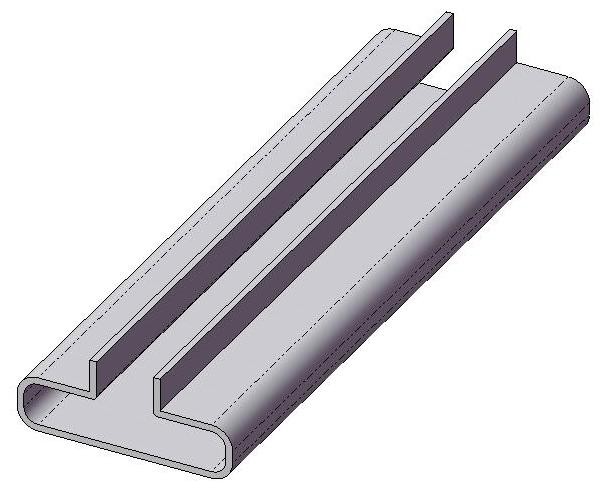 |
| Aluminum Slatwall Inserts guide the Plexiglas. |
I used scrap wood to frame my doorway and bought the rest of my materials from Lowe’s Home Improvement Store. Lowe's sells the Lucite in 18” X 24” sheets and the aluminum slatwall inserts in 6’ strips. I had the store cut both in half for me, so what I took home was two 18” X12” panels of Lucite and two 3' strips of slatwall. If I had bought the wood there, I suppose they would have cut that, too. My timer is just a standard $4 lamp timer, also from Lowe's.
All I had to do when I got home was (using an existing entry into the chicken house):
- Nail the aluminum slatwall to a wide edge of the longer 2x4s. The nail will go right through the metal; just be sure it is flush and straight and that you don't bend the metal;
- Nail one side board into place;
- Insert a Plexiglas panel into the track and the other side board, slide it up and down to make sure the fit is secure but not binding, and nail the second side board into place. Then, with the Plexiglas inserted, nail the bottom sill into place to hold it. And finally, nail the top board in place. It was very, very easy.
 |
| The closed door sits in a groove for added security. |
I used the remaining half of my Lucite sheet to cover the top of the opening in my door. I tacked it tightly against the tracks as a permanent cover, but that was necessary only because I started with an opening that was twice as tall as I wanted in the first place. If you are starting from scratch, cut an opening exactly the size you need and be done with it. Share the extra Lucite with a friend.
Although the framing went well, the motor is a different story. I started with a motor that was too complicated for me and wasted quite a bit of time before I finally gave up on it and found a simpler one that I could install, adjust, and maintain by myself.
The first motor was the DIY model described on Chris and Keri's Blog. I liked it because it was inexpensive and hand-made and clever, but in retrospect, Oh My God, What was I thinking?! Chris and Keri's motor is a mass of electrical wiring and limit switches and a jerry-rigged screwdriver with a soldered circuit board that I don't even begin to understand. Look at Chris and Keri's material list carefully. If you don't recognize the parts or know what they're for or how they work, possibly this motor is not the best choice for you either, Grasshopper.
Master Po: Close your eyes. What do you hear?
Young Caine: I hear the water, I hear the birds.
Master Po: Do you hear your own heartbeat?
Caine: No.
Master Po: Do you hear the grasshopper which is at your feet?
Caine: Old man, how is it that you hear these things?
Master Po: Young man, how is it that you do not?
Pilot episode of Kung Fu (1972)
My friend Keith built Chris and Keri's motor for me; all I had to do was make it work. But I had immediate problems with the limit switches, which I never got the hang of, and after I had fiddled with the screwdriver for a while, it stopped working, too. The underlying problem was that I could not hear the grasshopper of the assembly which was at my feet. Although Chris and Keri's design is a boon to those with better ears, my destiny lay with a factory-built model and a warranty.
 |
| Add-a-Motor Chicken Coop Motor Model D20 |
It took me the better part of a day to wire and install an electrical receptacle in the chicken house and it took all of the following morning for me to digest the instructions and install the motor, scrounge up a timer, set it, plug it in, and test it. But that night at 8:30 sharp, a gentle whir announced the door was closing, and the next morning my birds were outside and on the job before I was. The machine is a Godsend.
Subscribe to:
Posts (Atom)